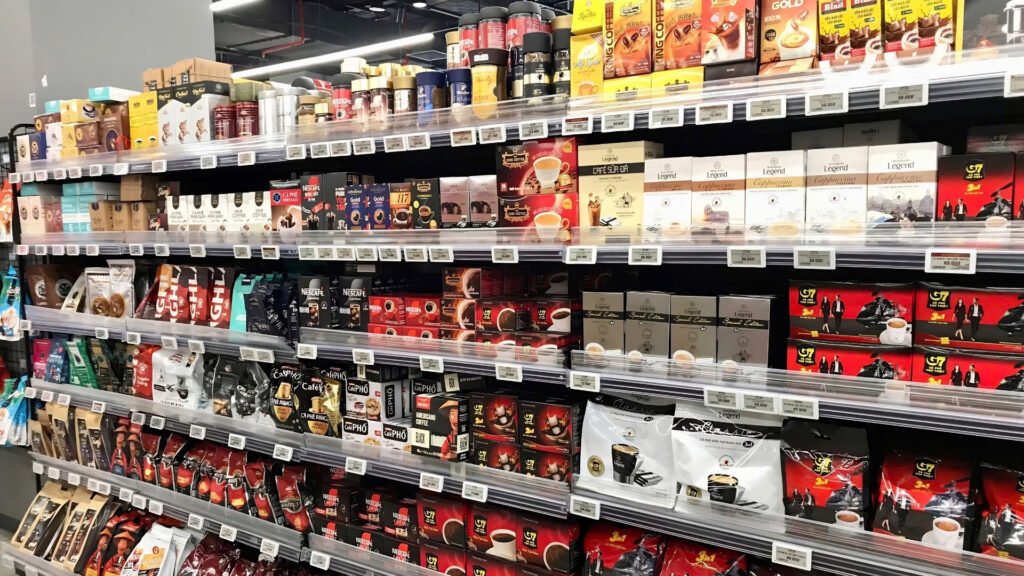
In 2025 – 2026, Vietnam’s coffee market continues to evolve toward greater convenience and product diversification, with ready-to-drink (RTD) coffee showing positive momentum. According to Euromonitor, innovation in RTD coffee is increasingly focused on flavour, product functionality, and sustainable packaging, while modern retail and e-commerce channels continue to expand. These trends are pushing companies to continuously develop new products while maintaining consistent quality, process control, and production flexibility, increasing the need to modernise manufacturing operations.
Challenges Faced by Manufacturing Plants
- Aroma is the most vulnerable value throughout the processing chain: A coffee brand’s distinctive character depends heavily on the aroma developed during extraction and preserved through concentration, cooling, and drying. These are interconnected thermal processes in which temperature, pressure, and flow variables must be tightly controlled. Even a brief deviation from the required operating range can alter the product’s intended characteristics in ways that cannot be corrected at later stages.
- Green coffee quality varies across lots and harvest seasons: The quality of green coffee beans changes by growing region and crop season, making precise control of receiving, dosing, and blending essential to maintaining consistent finished-product quality. When these stages still depend on manual operations, manufacturers face difficulties in ensuring consistency and lack sufficient data for traceability when quality issues arise.
- Aroma-generating processes are also among the most energy-intensive: Concentration, cooling, and deep-freezing systems operate continuously and account for a significant share of energy consumption in instant coffee plants. Without centralised monitoring and heat recovery, energy cost per tonne of finished product can continue to rise with electricity prices, while the plant lacks the data required to identify improvement opportunities.
- Legacy control systems and communication networks restrict expansion: Many factories continue to operate using communication networks and supervisory software that have been in service for decades, with a single controller sometimes managing multiple equipment areas. This architecture increases the technical risk of relocating equipment or expanding production lines, while also limiting reporting capabilities and integration with corporate management systems.
Tan Tien’s Solutions
1. Green Coffee Receiving and Dosing System: Provide hardware solutions and batch-control software for raw-material receiving and handling areas.
- Applications
- Batch control systems for green coffee receiving and processing
- Separation of the existing control system into two controllers serving two independent process areas
- Preparation of a control architecture to support future equipment relocation and system expansion
- Upgrade of the control network from ControlNet to EtherNet/IP
2. Extraction, Aroma Processing and Refrigeration Systems: Design, supply equipment and materials, and provide technical services for electrical panel integration across coffee processing systems.
- Applications
- Aroma processing system and extract storage tanks
- Granulation system
- Pre-cooling system
- Freezing and refrigeration systems
- Complete system design and configuration
- Preparation of detailed documentation and drawings
- FAT and SAT
3. Concentration, Cooling and Heat Recovery Systems: Design, install, and program high-energy-consumption systems to improve plant operating efficiency.
- Applications
- Cooling and refrigeration systems
- Concentration systems
- Heat recovery systems
- Supply of equipment and materials and electrical panel installation
- System programming and commissioning
- Training and technology transfer for system operation, maintenance, and servicing
4. Automated Control System for Barista Equipment: Design and program the automated control system for Barista equipment at the plant, including system testing and commissioning.
5. SCADA Platform and Modernisation of Existing Control Systems: Upgrade and improve the supervisory control system for operating instant coffee production lines while minimising disruption to production.
- Scope
- Upgrade control equipment and supervisory systems for instant coffee production lines
- Supply equipment and integrate it with existing remote I/O panels and control panels
- Review the existing process and the proposed improved process
- Provide complete drawings, documentation, control programmes, and software
- Install and modify electrical panels at the plant
- Installation, programming, commissioning, training, and handover
6. Electrical Infrastructure and Plant Safety: Deploy protection systems to ensure safe and continuous plant operation.
- Includes:
- Faraday cage direct lightning protection system for the entire plant
- Earthing system
- Material supply, design, installation, training, and technology transfer
7. Maintenance and Operational Support Services: Maintain system availability after production start-up.
- Services:
- Variable frequency drive and PLC repair
- Remote technical support via hotline
- On-site repair and maintenance
- Scheduled preventive maintenance under service contracts
- On-site training for plant operating teams
Implementation Benefits
- Maintain consistent product aroma and flavour through synchronised control of extraction, concentration, and cooling processes
- Control green coffee receiving and dosing by batch to improve finished-product consistency
- Reduce energy cost per tonne of finished product through optimisation of concentration, cooling, and heat recovery systems
- Separate the control architecture by process area, enabling future equipment relocation and production-line expansion
- Use modern communication networks and SCADA platforms to support centralised monitoring, remote access, and integration with corporate management systems
- Extend the lifecycle of existing control systems through phased upgrades
- Protect the plant against lightning and electrical risks, reducing the likelihood of unplanned production downtime
In the coffee industry, Tan Tien works with Nestlé, the world’s largest food and beverage company and the owner of Nescafé, the world’s leading instant coffee brand, across its manufacturing facilities in Tri An, Binh An, and Dong Nai. Tan Tien also works with Vinacafé Bien Hoa, home to Vietnam’s first instant coffee plant with more than fifty years of operating history, as well as its Long Thanh facility.
Given that aroma is a core product value yet highly sensitive to variations in temperature and pressure, while the associated processing stages are also highly energy-intensive, Tan Tien provides solutions ranging from system design and electrical panel integration to control-system modernisation. These solutions help stabilise flavour quality, optimise energy consumption, and establish a stronger data foundation for production management.